Why understanding bank bill payment charges matters
Paying bills through a bank can save considerable time. A parent, for example, can pay school fees from home in minutes instead of spending half a day at the bursar’s office, while a business can settle taxes without sending staff to queue at the Uganda Revenue Authority (URA). Digital channels such as mobile banking applications and USSD menus also offer 24/7 access, reduce reliance on cash, create clearer transaction records and make disputes easier to resolve. However, this convenience may come at a cost. Even small fees can add up when you regularly pay utility bills, school fees or several household obligations. Understanding these charges helps you calculate the true cost of each payment, compare providers and choose the most cost-effective option.
The different ways to pay bills through your bank
Depending on the bank and the biller, you may be able to pay through a mobile banking application, internet/online banking, a USSD menu, or an ATM. The steps are generally similar: select the bill-payment option, choose the biller, enter the customer or reference number, confirm the amount and any displayed fee, and authorise the transaction.
- Mobile banking applications: These usually provide the widest range of billers and allow you to save frequent payments for faster repeat transactions.
- Internet banking: This option is useful when you prefer to pay from a computer, review detailed payment information, or manage several bills at once.
- USSD banking: By dialling your bank’s short code, you can make payments from a basic mobile phone without mobile data, although menu options and transaction limits may vary.
- ATMs: Some banks allow customers to select a biller, enter a reference number and complete a payment using a debit card and PIN.
Whichever channel you use, check that the biller name and reference number are correct before confirming the payment. Review the charge shown on screen, keep the receipt or confirmation message, and confirm that the biller has credited your account. The best option is the one that supports your bill, is convenient for you, and offers a reasonable total cost.
Comparing bank charges on bill payments
We compared the published mobile banking bill payment tariffs of 21 banks across seven bill types: airtime, school fees, electricity (UEDCL Light), Water (NWSC), Pay TV (DSTV, GoTV, Star Times, etc.), URA tax payments, and NSSF saving contributions. We show you that what you pay depends on which bank you use and what you are paying for just as much as the amount you are paying.
Fees in the table below are in UGX per transaction, as published by each bank.
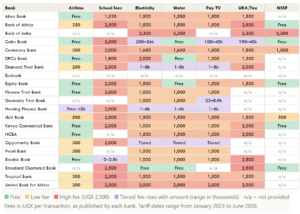
The following are the key patterns we spotted in the data:
- Flat fees punish small payments while tiered fees quietly penalise higher‑value bills. Consumers who buy small often pay the most per shilling. Banks with tiered pricing look cheap at first glance, until your bill crosses a certain amount. This can be seen by the effective cost which tells you what that fee means relative to what you are paying:
Effective cost (%) = fee ÷ amount paid × 100.
For a basket of several bills: total fees ÷ total bills paid × 100.
Take a flat UGX 1,500 fee:
| Amount paid (UGX) | 10,000 | 20,000 | 50,000 | 200,000 | 1,000,000 |
|---|---|---|---|---|---|
| Effective cost of a flat UGX 1,500 fee | 15% | 7.5% | 3% | 0.75% | 0.15% |
The same logic explains why airtime is the costliest category in percentage terms (UGX 300 on UGX 5,000 is 6%) and tax and school fees the cheapest (UGX 2,500 on a UGX 5 million URA payment is 0.05%).
2. Households with higher consumption end up paying significantly more. Larger bills can move customers into higher fee bands, so the total charge rises even when the payment process is unchanged. This makes it important to compare the fee at your typical bill amount, not just the lowest advertised rate.
3. Banks price a “bill type”, not each biller. At most banks, electricity, water and Pay TV attract the same charge because they are processed under a common utility or bill-payment category. Where one bill—such as water—is free, the difference is more likely to reflect a targeted promotion or biller arrangement than a lower cost for that category overall.
A worked example
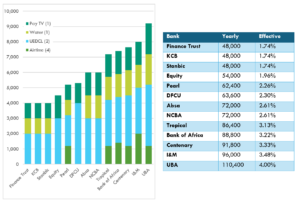
We priced the same month of bills at every bank that publishes a complete flat fee for these four bill types. The bill amounts below are illustrative assumptions.
| Bill type | Payments | Amount each (UGX) | Total paid (UGX) |
|---|---|---|---|
| Airtime | 4 | 10,000 | 40,000 |
| UEDCL Light | 2 | 50,000 | 100,000 |
| Water | 1 | 40,000 | 40,000 |
| Pay TV | 1 | 50,000 | 50,000 |
| Total | 8 | 230,000 |
Each bank’s fee for each bill type is multiplied by the number of payments (for example, a UGX 300 airtime fee × 4 = UGX 1,200). The chart shows the monthly cost at each bank, cheapest first, and the table shows the estimated annual and effective costs, assuming equal monthly spending throughout the year.
The results show that the cheapest banks (Finance Trust, KCB, Stanbic) cost UGX 48,000 a year, an effective cost of 1.74%. UBA costs UGX 110,400, or 4.0%, 2.3 times more for identical bills, a gap of UGX 62,400 a year. Banks with tiered fees (Cairo, DTB, Housing Finance, Opportunity) and banks with missing prices (Bank of India, Ecobank, Guaranty Trust Bank, Standard Chartered) were excluded.
Why the charges differ by bank and bill type
You may wonder why one bank charges more than another for the same bill. Several factors explain this variation:
- Integration with billers: Banks with direct system links to utilities or schools often reduce processing costs, resulting in lower fees.
- Cross-bank settlement: If your bank is not the designated collection bank, payments must be routed through another institution, adding costs.
- Revenue strategies: Because banks are businesses, some banks treat bill payments as a way to reduce cash handling since it gets tedious and expensive, while others view them as a revenue stream.
- Compliance and security: Investments in fraud monitoring and cybersecurity such as secure payment systems and real time transaction monitoring raise operational costs and these often influence pricing.
Tips on how to pay less
- Choose low flat fees for frequent payments. If you pay several bills each month, consistently low charges can save more than occasional fee-free offers.
- Match the bank to your main bills. Frequent airtime buyers should prioritise free airtime, while regular water customers can compare fee-free options from DFCU, Equity, Cairo and Standard Chartered.
- Check tier thresholds for large bills. A low starting fee can rise sharply when your payment enters a higher band.
- Combine payments where practical. Buying one UGX 100,000 Light token instead of two UGX 50,000 tokens avoids one fee, saving UGX 18,000 a year at UGX 1,500 per transaction.
- Check the final amount for surcharges and taxes. The stated service fee may not be the full cost: taxes or other levies can be added at confirmation, so review the total amount to be debited before authorising the payment.
- Verify the fee for your payment channel. Charges may differ across mobile apps, USSD, internet banking and agent banking, so confirm the amount before paying.
- Check limits and your balance. Make sure the payment is within the channel limit and that your account can cover both the bill and the fee.
Conclusion
Bill payment fees may look negligible in isolation, but every shilling counts. A nominal charge can represent a substantial effective cost when measured against a small payment, and repeated fees across utilities, school fees, taxes and other obligations can add up to tens of thousands of shillings a year, money that could instead support groceries, textbooks or other household needs.
The good news is that many banks keep digital bill payment charges relatively low, and some offer fee-free options for selected bills. Even where a fee applies, paying digitally may still cost less than travelling to a branch once fuel, transport fares and time spent in queues are considered. The practical advantage comes from looking beyond the headline fee: compare the effective cost at your usual payment amount, identify the bank and channel that charge least for your main bills, and plan or combine payments where appropriate.
Simply Mint makes comparison of published tariffs easier, while payments made through licensed and regulated banks are secure and traceable and may be easier to resolve if an error, duplicate charge or failed transaction occurs. Visit our website at https://simplymint.ug/ to compare more bank charges and products.