Introduction
On 21 October 2026, Platinum Credit Uganda rang the bell at the Uganda Securities Exchange (USE) in Nakawa to mark the listing of UGX 30 billion of medium-term notes, which were admitted to the exchange on 5 October. It looks like a niche event, but it is the first new corporate bond issue on the exchange since Kakira Sugar’s UGX 76 billion bond in December 2013, and it comes at an awkward moment: a week before the ceremony, the Bank of Uganda (BOU) raised its policy rate by 2.25 percentage points. Here is what happened, and why it matters to borrowers, savers and the banks you deal with.
What is the Uganda Securities Exchange?
The USE is Uganda’s licensed stock exchange, regulated by the Capital Markets Authority (CMA). It is where companies list shares to raise equity and where corporate bonds and notes can be listed. Its benchmark, the All Share Index (ALSI), tracks all listed equities, weighted by market capitalisation. That includes 11 locally listed companies and a group of Kenyan companies cross-listed in Kampala.
The locally listed equity market stood at UGX 24.1 trillion at the end of August 2026, compared to corporate debt which has been almost absent: the CMA recorded no primary or secondary corporate bond activity in the year to June 2025, and only nine corporate bond issuers have used the exchange since 1998.
How has the USE performed in 2026?
It has been a strong year for equities, helped by earnings growth, dividends and falling interest rates earlier in the year.
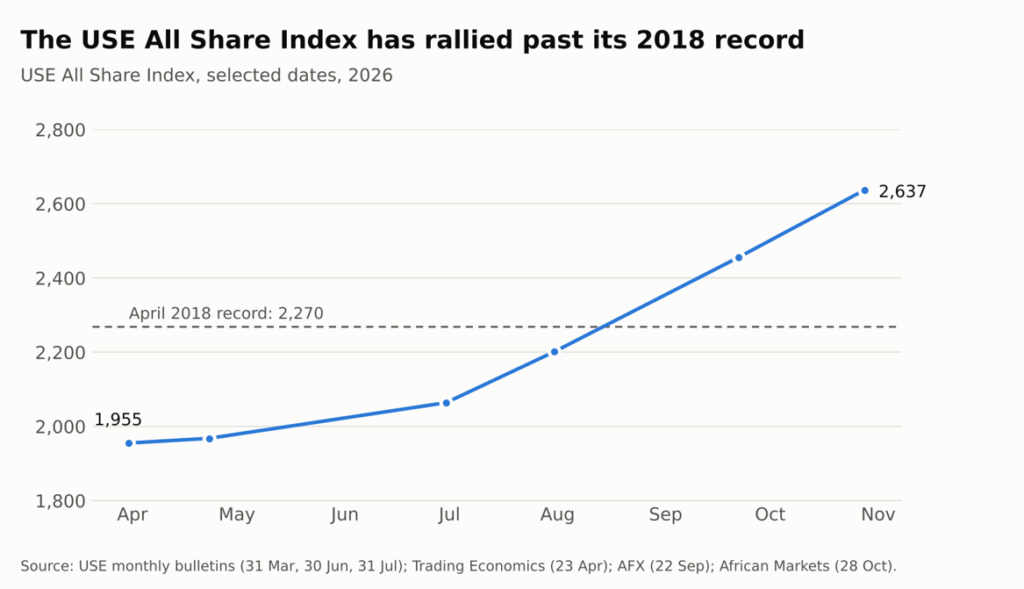
By late October, the All Share Index was about 34% higher than in late April and about 28% higher than at the end of June, well above the 2,270 peak of April 2018 that Trading Economics cites as its all-time high. Total market capitalisation reached UGX 51 trillion by end-August, up from UGX 31 trillion a year earlier, with locally listed companies alone rising from UGX 15 trillion to UGX 24.1 trillion. Trading almost doubled too: equity turnover to 31 August was UGX 101.8 billion, against about UGX 56 billion a year earlier.
The rally rests on a narrow base, though. In July, Stanbic and MTN together accounted for about 89% of equity turnover, and the exchange’s CEO has pointed to pricing on those two counters as the main driver of the gains. Many other counters go days without a trade: on 27 October, only four counters traded, for a total of about UGX 18 million.
Which financial institutions are listed, and how are they doing?
Financial institutions are the heart of the USE. Four are listed locally (Stanbic, Bank of Baroda, dfcu and NIC) and three are cross-listed from Nairobi (KCB, Equity and Jubilee). Here is where they stood after their half-year (January–June 2026) results.
Performance of financial institutions on the USE, January–June 2026
| Institution | Listing | H1 2026 result | Notes |
|---|---|---|---|
| Bank of Baroda Uganda | Local | Profit UGX 91.3 billion, up 24.4%, its best first half in published statements since 2018 | Core capital ratio 31.17% (well above regulatory minimums). Final dividend of UGX 6 per share declared in July. Shares roughly tripled between January 2025 and September 2026. |
| Stanbic Uganda Holdings | Local | Profit after tax UGX 357 billion, up 28.2%; total assets UGX 13.4 trillion | Full-year 2025 profit was UGX 591 billion, up 23.6%. Share price hit a record UGX 90 on 10 August, from the low UGX 60s at the start of the year. |
| NIC Holdings | Local | Insurance revenue down about 16% to UGX 13.84 billion; total equity UGX 40.04 billion | Insurer, formerly National Insurance Corporation. Cornerstone Asset Managers is buying a majority stake, pending regulatory approval. Shares rose from UGX 5 to about UGX 24.56 between 30 April and 27 October, on very thin trading. |
| Jubilee Holdings | Cross-listed (Kenya) | Net profit KSh 3.45 billion, up 12.7%; pre-tax profit KSh 4.42 billion, up 30% | Insurer. Interim dividend held at KSh 2 per share. Profit was lifted by investment and other income while insurance service profit fell. |
| KCB Group | Cross-listed (Kenya) | Net profit KSh 36.1 billion, up about 14%; pre-tax profit KSh 49.3 billion, up 20.8% | Interim dividend raised to KSh 3. KCB Bank Uganda acted as receiving bank on the Platinum notes. |
| dfcu Limited | Local | Net loss of UGX 15.8 billion, against a profit of UGX 34.5 billion a year earlier | Pre-tax loss of UGX 26.3 billion, blamed largely on legal costs from the Crane Bank case in London. Underlying balance sheet grew: customer deposits rose about UGX 410 billion and the bank's total assets reached UGX 3.94 trillion. Shares were at UGX 337 at end-July. |
| Equity Group | Cross-listed (Kenya) | Profit after tax KSh 45.5 billion, up 32%; pre-tax profit KSh 57.8 billion, up 39%; return on equity 26.5% | Regional subsidiaries now contribute 42% of banking profit. |
What did Platinum Credit actually do?
Platinum Credit Uganda, part of the Platcorp Group and regulated by the Ministry of Finance’s Microfinance Regulation Department, raised money by selling notes in a private placement. The notes were issued on 30 September 2026 and admitted to listing on the USE on 5 October.
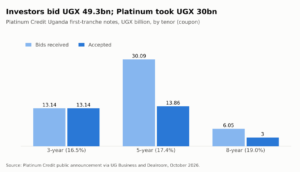
The first tranche was meant to raise UGX 20 billion, with a UGX 10 billion greenshoe option. Investors bid UGX 49.28 billion, a subscription of 246%, so Platinum exercised the option and took UGX 30 billion. The tranche sits under a medium-term note programme of UGX 70 billion plus a UGX 30 billion greenshoe, a UGX 100 billion ceiling in total, and further tranches can be issued as funding is needed.
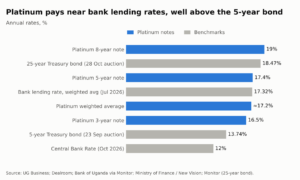
The notes pay fixed coupons quarterly: 16.5% on the 3-year notes, 17.4% on the 5-year notes and 19% on the 8-year notes. On the amounts accepted, that works out to a weighted average of about 17.2%, or roughly UGX 5.15 billion of interest a year on the UGX 30 billion.
The buyers were pension funds, asset managers and high-net-worth individuals. Bids on the 5-year series were the largest, but Platinum accepted under half of them, and it took only UGX 3 billion of the UGX 6.05 billion bid on the 8-year series. For now, only the original investors can trade the notes.
The route itself was new. Rules the CMA introduced in January 2025 created a formal path for private placements and allow justified waivers, which let Platinum move from private sale to listing.
What does this mean for a lender that cannot take deposits?
Banks mostly fund themselves with customer deposits: current accounts, savings and fixed deposits. A credit-only microfinance institution like Platinum is not allowed to do that. Its money has to come from somewhere else: shareholders’ equity, borrowing from banks, and loans from development and impact investors.
That last source can be expensive in a way that is easy to miss. In December 2025, for instance, Platinum received a US$4 million, 24-month facility from Symbiotics, a Swiss impact-investment manager. Money like that is borrowed in dollars and lent out in shillings. When the shilling weakens (it had lost about 11% against the dollar by mid-October 2026) the lender’s repayment burden rises even though its loan book has not changed.
The note programme changes the funding mix in three ways:
- Local currency. Shilling funding for shilling loans removes the currency mismatch. Platinum’s Managing Director has said part of the proceeds will repay foreign-currency debt.
- Longer tenor. Three to eight years is far longer than the typical bank credit line to a microlender, so the lender is less exposed to having to refinance at the wrong moment.
- A broader investor base. Pension funds and asset managers become funders, which reduces reliance on a handful of banks and development funds.
What has not changed is that notes are still debt. There is no deposit-style cushion of small, sticky balances, and the lender must keep earning enough on its loans to pay a fixed coupon every quarter.
Why would Platinum do this now?
Platinum has given its own reasons: more lending to customers, better management of exchange-rate risk, repaying some foreign-currency debt, and new loan products that are easier for borrowers to repay. Based on the wider market picture, a few other factors likely played a part (our analysis, not Platinum’s statement):
- Timing. The notes were priced and sold before the Bank of Uganda’s emergency hike on 14 October. Locking in fixed coupons just ahead of a rate rise looks well judged in hindsight.
- A currency under pressure. With the shilling sliding through 2026, shifting from dollar to shilling funding was a sensible hedge.
- A rule change and an investor appetite gap. The January 2025 private-placement rules lowered the barriers. Meanwhile, institutional investors had few corporate options and were willing to accept a premium: the 5-year coupon of 17.4% was about 3.7 percentage points above the 13.74% the government paid on a 5-year bond at its 23 September auction.
- Credibility. Platinum’s Managing Director called the demand a sign of investor trust in how the business is run, and a listed issuer faces ongoing disclosure obligations, which can help when approaching other lenders and investors.
What happens to the cost of credit?
For Platinum’s own funding costs, the fixed coupons protect this tranche from the rate rise. The more important point is that an average of about 17.2% is not cheap. It is close to what banks were charging on shilling loans (a weighted average of 17.32% in July 2026) and will be well above what Platinum would pay if its funding came from a deposit base. Issue costs (advisers, trustees, registrars) come on top, and Platinum has not disclosed them. Further tranches will likely price higher: on 28 October the 25-year Treasury bond cleared at 18.47%, and the policy rate is now 12%, up from 9.75%. The BoU held it there on 9 November.
For borrowers, we could not find Platinum’s lending rates published alongside the issue, so we cannot say what its customers will pay. Directionally:
- Funding cost, operating cost, loan losses and margin together make up a loan’s price. With funding at about 17% and rising, do not expect near-term price cuts on microloans.
- The realistic gains are in loan terms and stability: longer repayment periods, and no pass-through of currency swings into the cost of credit.
Across the wider market, bank lending rates had been easing (16.93% in June 2026) before ticking up to 17.32% in July. Since then, the BOU has tightened twice: it raised the share of deposits banks must hold at the central bank from 11% to 13.5% from 24 September, then raised the policy rate to 12% in October. With inflation at 5.8% in October (up from 4.6% in September) and the BOU expecting core inflation to average 6% to 6.5% and headline inflation 7.5% to 8% over the next year, the pressure is now upward.
What does it mean for banks and other listed institutions?
A template for non-bank and bank funding. If the exchange can handle a mid-sized issuer, others (leasing firms, SACCOs that have grown large, even banks seeking longer-term capital) may follow. The USE has asked the CMA for authority to approve repeat issues in under a month for issuers with a current credit rating, and short-term commercial paper is seen as a quicker fix. Ratings are a bottleneck: Uganda has only one licensed rating agency.
- Competition for institutional money. Pension funds and asset managers now have a corporate option paying well above Treasuries. If more issuers arrive, banks competing for the same wholesale funds may have to pay more.
- Banks’ MSME lending. Banks have been loosening lending: private sector credit reached UGX 27.74 trillion in June 2026, up 16% year on year. Platinum targets small businesses and households, a segment banks often find costly to serve, so it is more likely to complement than displace banks. But if non-bank lenders can fund themselves cheaply at long tenors, they become tougher competitors in the small-loan segment.
- Credit quality risk. The BOU has warned that shilling depreciation raises repayment burdens and could lead to more non-performing loans. A listed lender holding unsecured MSME loans will test that warning, and so will banks.
- Governance. The CMA’s director of market supervision has called listing the start of an issuer’s obligations. How well Platinum meets its use-of-proceeds and disclosure commitments will shape whether others follow.
- Equities. Higher yields on bonds and Treasuries compete with shares. After this year’s rally, the USE equity market, with its narrow turnover and heavy reliance on Stanbic and MTN, is more exposed to a shift in investors’ preferences than the index level suggests.
What this means for you
- Borrowers: Ask any lender, including Platinum, for the full cost of a loan (interest, fees, insurance) and the repayment schedule before signing. Our guide to upfront loan costs and the Loan Calculator can help.
- Savers and investors: Higher coupons mean higher credit risk. Corporate notes are not guaranteed by the government or covered by deposit insurance, and trading in them is thin. Platinum’s announcements do not mention a credit rating for the notes. Use the Bond Calculator to compare after-tax returns with Treasury bonds before committing.
This article is for information and is not investment or financial advice.
Sources
- Platcorp Group press release via African Newspage: first tranche subscribed nearly 2.5 times (8 October 2026)
- bne IntelliNews: Uganda’s first corporate bond since 2013
- UG Business: Platinum draws Shs49bn of bids
- Dealroom: Platinum Credit raises $7.48M
- Monitor: 13 years of no activity
- New Vision: Platinum Credit lists notes on USE
- USE monthly bulletin, March 2026; USE monthly bulletin, July 2026
- Trading Economics: Uganda stock market
- AFX: Uganda Securities Exchange (22 September 2026); African Markets: USE (28 October 2026)
- Cornerstone Asset Managers: Daily Market Insights, 28 October 2026
- Monitor: USE turnover nearly doubles
- Monitor: How Uganda’s stock market is making people rich
- Stanbic Uganda Holdings H1 2026 results (USE); New Vision: Stanbic shares hit sh90
- UG Business: Bank of Baroda profit; AfricanFinancials: Bank of Baroda Uganda H1 2026
- The EastAfrican: dfcu half-year loss; New Vision: dfcu balance sheet
- AfricanFinancials: NIC Holdings HY2026 interim report; Dealroom: Cornerstone nears majority takeover of NIC Holdings
- Rio Times: KCB half-year profit; Rio Times: Equity Group half-year profit; AfricanFinancials: Equity Group HY2026 interim report
- AfricanFinancials: Jubilee Holdings HY2026 interim report; Business Daily: Jubilee maintains dividend
- Monitor: BoU raises rate to 12%; Monitor: BoU tightens money supply (cash reserve requirement); Monitor: BoU holds lending rate at 12%
- Monitor: Ggoobi’s cheap debt promise
- Ministry of Finance Performance of the Economy reports, 2026; New Vision: loan approvals
- Trading Economics: Uganda inflation, October 2026